⚖️ 2026 Legal Reality Check
Can an operator use a single license for the entire EU? No. Online gambling is regulated at the national level, not by the European Union. While EU “Horizontal Laws” (GDPR, AMLD5) apply across the bloc, every member state has the sovereign right to require its own local license. Operating in Germany with a Malta (MGA) license, for example, is considered “unlicensed” by German authorities (GGL) and carries high enforcement risk.
👉 Jump to Latest Q1 2026 Key Updates to iGaming Regulations in the EU
What this guide covers: a practical 2026 snapshot of how online gambling is regulated across the EU, what the EU does and does not control, where operators usually get into trouble, and how to verify the latest legal position using official regulators and public sources.
Who this is for: players, journalists, researchers, affiliates, and especially operators or suppliers evaluating EU market entry, compliance exposure, licensing reality, and product restrictions.
What counts as “iGaming”? iGaming includes any gambling activity offered online, such as:
- online casinos (roulette, blackjack, slots, live dealer)
- sports betting (pre-match, in-play, exchanges where allowed)
- poker (cash games, tournaments, sometimes peer-to-peer formats)
- lotteries (including online lottery sales where legal)
- slots and online casino content, which are often the first product category to be restricted in “partial” or monopoly-led markets
Important: this is general information, not legal advice. Gambling law changes frequently, and the same country may treat casino, sports betting, poker, lottery, advertising, payments, and affiliate activity differently. If you need certainty for licensing, market entry, or compliance, verify with the official regulator and local counsel.
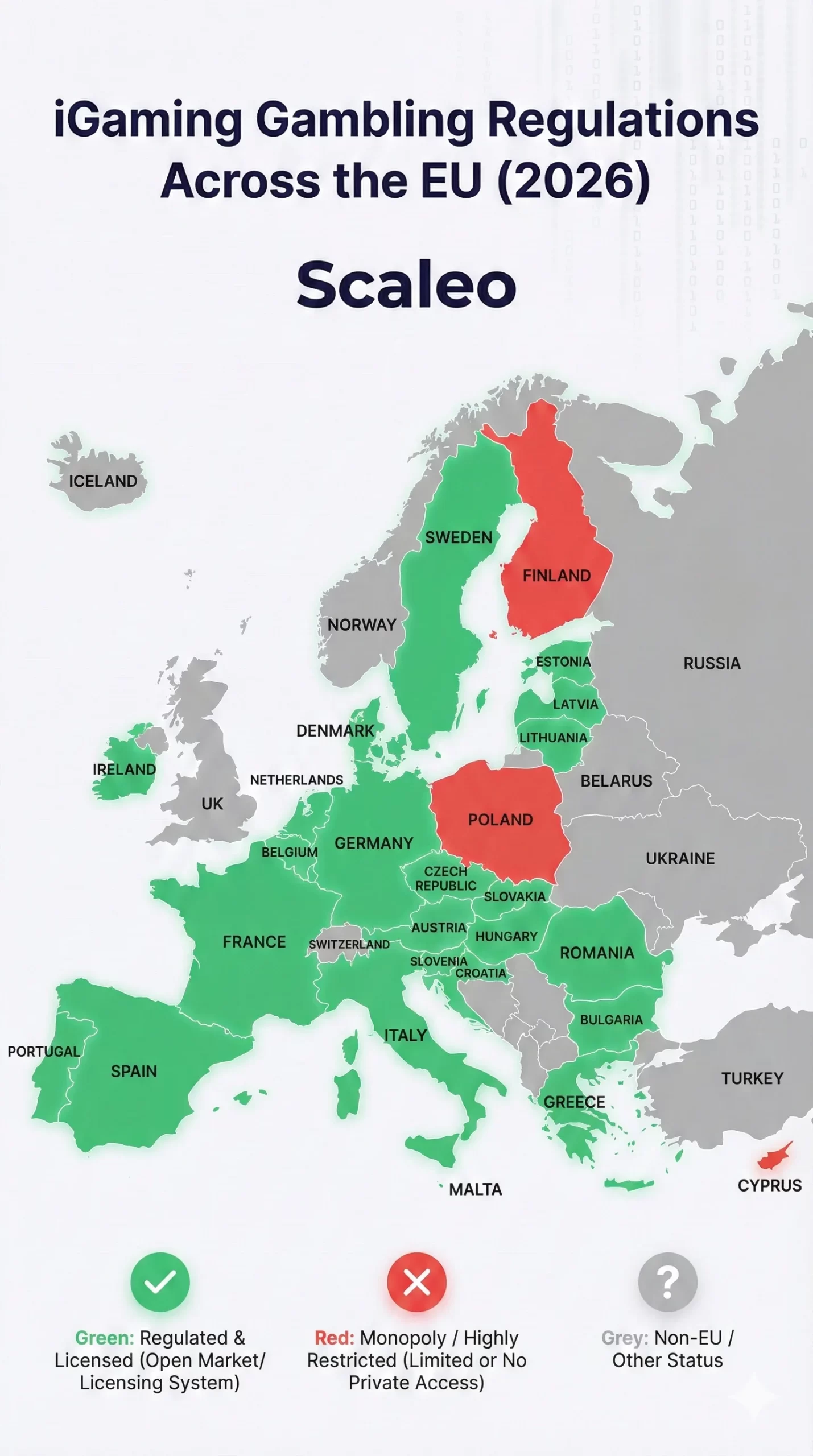
iGaming Regulations Across the EU (2026 Snapshot)
Legend: 🟩 = broadly legal and licensed for major online products 🟨 = partial, limited, or tightly segmented regime 🟥 = online casino generally prohibited, monopoly-led, or available only through narrow legal routes. This is a high-level product-market snapshot, not a substitute for a product-by-product legal review.
| Market | Online Slots | Sports Betting | Online Poker | Affiliate Marketing |
|---|---|---|---|---|
| 🇫🇷 France | 🟥 Prohibited | 🟩 Licensed | 🟩 Licensed | 🟨 Tightly Regulated |
| 🇩🇪 Germany | 🟨 €1 Stake Limit | 🟩 Licensed | 🟩 Licensed | 🟥 Highly Restricted |
| 🇳🇱 Netherlands | 🟩 Licensed | 🟩 Licensed | 🟩 Licensed | 🟨 No “Role Models” |
| 🇵🇱 Poland | 🟥 State Monopoly | 🟩 Licensed | 🟥 Prohibited | 🟨 Strict Penalties |
| 🇫🇮 Finland | 🟨 (Transitioning) | 🟨 (Transitioning) | 🟨 (Transitioning) | 🟨 Pending 2027 |
| Country | Regulations & status | Official regulator / legal resources |
|---|---|---|
| 🇦🇹 Austria | 🟥 Online casino remains largely monopoly-based; private operator routes are limited and enforcement risk is real. | Austrian Federal Ministry of Finance |
| 🇧🇪 Belgium | 🟩 Legal and regulated, but with strict local authorization, advertising restrictions, and active enforcement. | Belgian Gaming Commission |
| 🇧🇬 Bulgaria | 🟩 Legal and regulated under the national licensing framework. | National Revenue Agency (Bulgaria) |
| 🇭🇷 Croatia | 🟩 Legal and regulated, with licensing and Ministry of Finance oversight. | Ministry of Finance (Croatia) |
| 🇨🇾 Cyprus | 🟥 Online casino is generally not permitted; sports betting is the better-known regulated online route. | National Betting Authority (Cyprus) |
| 🇨🇿 Czech Republic | 🟩 Legal and regulated; licensing is national and compliance obligations are serious. | Ministry of Finance (Czech Republic) |
| 🇩🇰 Denmark | 🟩 Open licensed market with mature responsible gambling and advertising controls. | Danish Gambling Authority |
| 🇪🇪 Estonia | 🟩 Legal and regulated; licensing and tax compliance are enforced nationally. | Estonian Tax and Customs Board |
| 🇫🇮 Finland | 🟨 Monopoly-led today, but moving toward a competitive licensing model in stages. Treat this as a transition market, not a fully open one yet. | Ministry of the Interior / Finland gambling reform |
| 🇫🇷 France | 🟥 Online casino remains prohibited; sports betting, horse racing, and poker are the classic regulated online categories. | ANJ (Autorité Nationale des Jeux) |
| 🇩🇪 Germany | 🟨 Regulated but tightly controlled, especially on product design, advertising, and enforcement. | GGL (Gemeinsame Glücksspielbehörde der Länder) |
| 🇬🇷 Greece | 🟩 Legal and regulated under the national licensing framework. | Hellenic Gaming Commission |
| 🇭🇺 Hungary | 🟥 Strong state-control tendencies and narrow routes for online casino activity. | National Tax and Customs Administration (Hungary) |
| 🇮🇪 Ireland | 🟨 A major modernization market: new legislation exists, but the licensing and regulator rollout is being phased in. | Government of Ireland |
| 🇮🇹 Italy | 🟩 Legal and regulated under ADM with heavy compliance expectations and concession logic. | ADM (Agenzia delle Dogane e dei Monopoli) |
| 🇱🇻 Latvia | 🟩 Legal and regulated under national licensing and supervision. | Latvian Gambling Supervisory Inspectorate |
| 🇱🇹 Lithuania | 🟩 Legal and regulated, with stricter enforcement and advertising controls than many operators expect. | Gaming Control Authority (Lithuania) |
| 🇱🇺 Luxembourg | 🟥 Online casino is generally not an open commercial online market; verify narrow exceptions carefully. | Ministry of Finance (Luxembourg) |
| 🇲🇹 Malta | 🟩 Major licensing hub with deep regulatory infrastructure under the MGA. | Malta Gaming Authority |
| 🇳🇱 Netherlands | 🟩 Legal and regulated, but increasingly strict on player protection, affordability, duty of care, and advertising. | Kansspelautoriteit (KSA) |
| 🇵🇱 Poland | 🟨 Partial and tightly controlled, with monopoly logic still relevant for parts of the market. | Ministry of Finance (Poland) |
| 🇵🇹 Portugal | 🟩 Legal and regulated under the national gambling authority. | SRIJ (Portugal) |
| 🇷🇴 Romania | 🟩 Legal and regulated; licensing and enforcement run through ONJN. | ONJN (Romania) |
| 🇸🇰 Slovakia | 🟩 Legal and regulated with national licensing and oversight. | Financial Administration (Slovakia) |
| 🇸🇮 Slovenia | 🟥 Heavily restricted with narrow legal routes and limited online gambling openness. | Financial Administration (Slovenia) |
| 🇪🇸 Spain | 🟩 Legal and regulated under DGOJ with strong marketing, bonus, and compliance controls. | DGOJ (Spain) |
| 🇸🇪 Sweden | 🟩 Legal and regulated under a mature licensing regime with strong player-protection controls. | Spelinspektionen |
| 🇬🇧 United Kingdom | 🟩 Highly regulated and commercially crucial, though no longer in the EU. Still worth tracking because it often influences the wider European compliance conversation. | UK Gambling Commission |
The Cost of Non-Compliance: How EU Enforcement Works in 2026
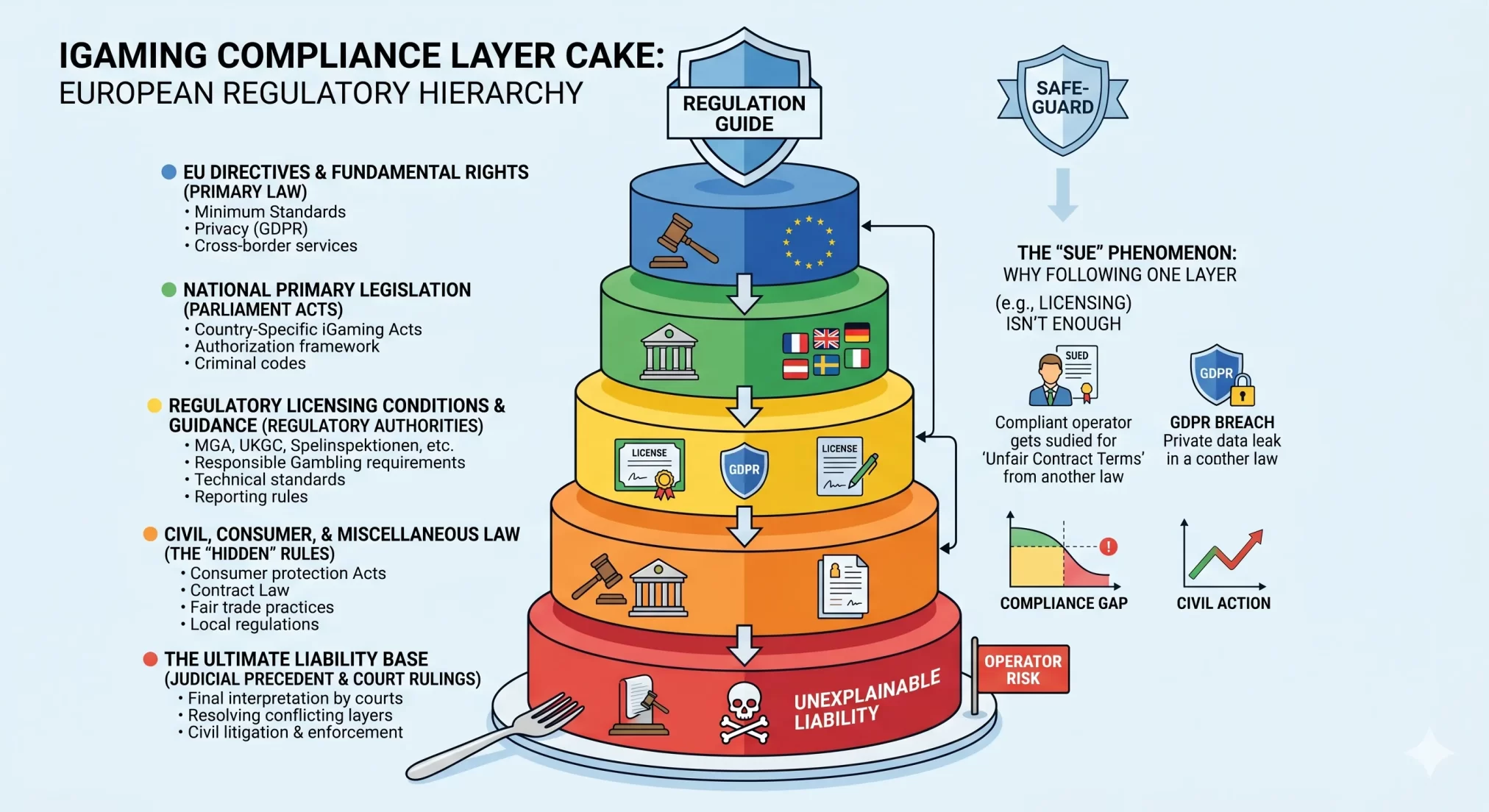
The EU is not one online gambling market. That sounds obvious, yet a remarkable amount of bad expansion planning starts by pretending otherwise. In practice, operators need to assess each target country across six separate layers: product legality, licensing route, player-protection controls, marketing rules, payments and AML exposure, and affiliate restrictions.
That is why “legal in Europe” is almost a useless phrase for commercial planning. The useful question is narrower: is this exact product, promoted in this exact way, by this exact entity, legal and licensable in this exact country?
License vs. Monopoly: How to Identify “White” and “Grey” Markets
Regulation is not just administrative noise. It determines whether an operator can lawfully accept players, process payments, advertise, run affiliate acquisition, intervene on risky behavior, and survive audits. For players, it affects fairness, withdrawal reliability, complaints handling, self-exclusion, and consumer protection. For operators, it determines whether growth is scalable or just temporarily lucky.
Put less politely: unregulated or misread markets tend to look profitable right up until enforcement, payment friction, or partner risk catches up with them.
The role of the EU in iGaming regulation
The EU shapes the compliance environment, but member states still control gambling legality. There is no single EU online casino act that opens or closes the market across all countries. Instead, the EU influences gambling through broader frameworks such as GDPR, AML directives, consumer law, digital rules, and court interpretations of treaty freedoms.
Think of the EU as setting the broader compliance climate, while each country decides the product reality: what is legal, who gets licensed, how monitoring works, and how aggressively violations are enforced.
Country-specific regulators and official resources (quick links)
If you want the fastest route to the truth, go straight to the regulator, ministry, or official legislative source. For operators, this matters because market-entry decisions built on summaries and affiliate-site hearsay tend to age badly.
| Country | What it does | Link |
|---|---|---|
| United Kingdom | Licenses and regulates gambling, publishes guidance, enforcement actions, and consumer-protection expectations. | UK Gambling Commission |
| Germany | National-level oversight and enforcement within the interstate framework. | GGL (Germany) |
| France | Regulates the authorized online segments and publishes enforcement and player-protection resources. | ANJ (France) |
| Italy | Licenses and supervises gambling concessions through ADM. | ADM (Italy) |
| Spain | Licenses online gambling and enforces compliance and advertising controls. | DGOJ (Spain) |
| Netherlands | Oversees licensed online gambling with a strong focus on duty of care and player protection. | Kansspelautoriteit (KSA) |
| Finland | Official source for the gambling reform moving the market toward a staged licensing model. | Ministry of the Interior (Finland) |
Use regulator websites for current law, licensing scope, public registers, and enforcement notices. Use articles like this one to orient yourself, not to replace primary-source verification.
Key features of iGaming regulation across Europe
Although every market uses its own legal model, the same themes keep repeating: age controls, identity verification, licensing, responsible gambling, AML, payment integrity, advertising restrictions, and technical accountability. The details vary. The logic does not.
Age limits
Age restriction is one of the most universal features of online gambling regulation. The exact age threshold can vary by country and, in some cases, by product type, but regulators treat underage access as a serious breach.
Across Europe, legal gambling access is typically adult-only, with age thresholds most commonly starting at 18 and sometimes higher depending on the market or the product.
For operators, this is not a box-ticking issue. Age controls affect onboarding flow, KYC timing, payments, CRM, marketing segmentation, and enforcement exposure.
Verification and KYC
Identity verification is how licensed operators prove they are not serving minors, fraudulent users, sanctioned individuals, or high-risk accounts without adequate checks. In practice, KYC may happen at registration, before first deposit, before first withdrawal, or in response to risk signals.
In stricter markets, verification happens earlier, interventions are more predictable, and the tolerance for weak identity evidence is lower. Operators who treat KYC as an afterthought usually end up redesigning the onboarding journey later under pressure.
Licensing
Licensing is the legal permission structure that turns gambling from a risky commercial activity into a regulated one. It usually comes with product scope, technical standards, reporting duties, auditability, responsible gambling obligations, and financial controls.
What is an iGaming license?
An iGaming license is an authorization issued by a regulator allowing an operator to offer specified gambling products in a particular jurisdiction. It is never just a logo for the footer. It is an ongoing compliance relationship.
Why licensing matters commercially
Because licensing determines whether you can get paid, advertise, onboard players predictably, build trusted payment relationships, and defend the business if complaints or regulatory questions arise. A market may look attractive on paper, but if the licensing route is narrow, expensive, or operationally heavy, the commercial picture changes fast.
- Consumer protection: licensed markets usually require complaint handling, clearer terms, and stronger responsible gambling tools.
- Fraud and AML controls: licensed operators are expected to secure transactions and document suspicious activity handling.
- Technical accountability: licensed operators are expected to prove what happened, when, and why across key player and payment events.
How to identify a licensed operator
Most licensed operators display license details in the footer, but the only serious verification method is checking the official public register or regulator source where available. Footer badges are cheap. Official registers are not.
Responsible gambling
Responsible gambling includes the tools and obligations designed to reduce harm: deposit limits, reality checks, cooling-off periods, self-exclusion, safer-gambling messaging, and, in stricter regimes, more active monitoring of risky behavior. Mature regulators increasingly expect operators to detect and act, not merely display a support link and hope for the best.
This matters for operators because responsible gambling is no longer just a compliance page. It affects CRM, analytics, identity flows, product design, intervention logic, and audit evidence.
EU approach: national gambling law + EU horizontal law
The EU does not harmonize gambling into one rulebook. Member states keep broad discretion over gambling policy, especially when they justify restrictions on consumer protection, fraud prevention, or public policy grounds.
For the wider EU legal context, the most cited starting point remains the Treaty on the Functioning of the European Union (TFEU), together with EU-wide frameworks on data protection, AML, consumer law, and digital rules.
- Treaty on the Functioning of the European Union (TFEU): useful background for understanding why gambling remains nationally controlled despite EU internal-market principles.
- EGBA licensing overview: a useful orientation resource, though it is an industry source rather than a regulator.
Responsible gambling resources
If you are researching safer-gambling standards, enforcement thinking, and regulatory coordination, these are among the better-known reference points:
- Gaming Regulators European Forum (GREF)
- International Association of Gaming Regulators (IAGR)
- Council of Europe resources on match-fixing
If you are a player, the safest rule is simple: use operators licensed for your jurisdiction or clearly permitted to serve it. In partial or prohibited markets, offshore access can mean weak complaints routes, account restrictions, payment issues, and very limited recourse when something goes wrong.
- Check the license in the official register, not just the site footer.
- Read verification and withdrawal terms before depositing.
- Understand the product scope: some countries allow betting or poker but not online casino.
- Use safer-gambling tools such as deposit limits, cooling-off, or self-exclusion where needed.
For operators and suppliers, the real EU gambling model is not “Europe.” It is multi-licensing, local restriction management, and workflow discipline. Product legality, onboarding design, KYC depth, payments, ad controls, and affiliate governance can all vary sharply from one country to the next.
That means market entry should be treated as a structured launch project, not just a legal memo. The operators that move fastest usually do three things well: they verify product legality early, they build country-specific controls into the product and acquisition stack, and they keep evidence logs that finance, compliance, and marketing can all rely on.
Operator checklist before entering an EU market
- Confirm product legality by country and by product type: casino, betting, poker, lottery, and affiliate activity may be treated differently.
- Verify the licensing route: open license, concession, monopoly carve-out, or no meaningful route at all.
- Map onboarding and KYC timing: what must happen at registration, deposit, or withdrawal?
- Review advertising and bonus restrictions: many mature markets are stricter here than newcomers expect.
- Assess affiliate risk: partner acquisition rules, geo restrictions, creative controls, and proof of consent all matter.
- Align payments, AML, and KYB: if you can onboard a player but cannot defend the money flow, the market is not really operational.
Consider seeking local legal counsel before launch or expansion. In gambling, “close enough” is not a compliance strategy. It is a future case study in regret.
Here are some general links with information you may need before making your gambling business live:
- iGaming Affiliate Software: if you operate in multiple regulated or partially regulated markets, affiliate technology matters because geo controls, evidence logs, commission governance, and attribution consistency become compliance issues, not just marketing issues. Some of the better-known tools in the space include Scaleo, Affilka, Traffic Manager, Smartico, and BetConstruct.

Cybersecurity and anti-money laundering in EU gambling
In modern iGaming, trust is not branding. It is technical and operational control. European regulators care about cybersecurity and AML because gambling systems touch identity data, payment rails, fraud vectors, and suspicious transaction patterns at scale.
For players, strong security reduces the risk of identity abuse and payment problems. For operators, cybersecurity and AML are license-survival systems.
Why cybersecurity is non-negotiable
The baseline player journey is simple: register, deposit, play, withdraw. But every step touches sensitive data and financial infrastructure. That makes gambling platforms attractive targets for account takeover, social engineering, credential abuse, bonus fraud, and money-laundering attempts.
Regulated operators are as a result expected to run layered security: encryption, access controls, monitoring, secure handling of identity files, incident response, and auditable internal procedures. Security is not just technical architecture. It is also patch discipline, staff process, and evidence quality.
EU AML: protection from the shadow economy
AML expectations in gambling usually include identity verification, transaction monitoring, risk scoring, enhanced due diligence for higher-risk cases, and escalation paths when suspicious activity is detected. Serious regulators expect operators to detect patterns, document decisions, and cooperate with authorities where required.
The point is not theatrical paperwork. The point is whether the operator can show who the customer is, how money moved, why a decision was made, and what controls were applied.
The EU’s anti-money-laundering framework is commonly discussed through directives such as AMLD4 and AMLD5, as well as the wider EU AML package and the creation of AMLA.
Failure here does not just create a legal headache. It can create fines, operational restrictions, payout friction, and in severe cases, direct license risk.
Go the extra mile: build a safer gambling environment
A secure platform is more than a legal requirement. It is also a commercial advantage. Operators that explain verification requirements clearly, document safer-gambling tools properly, and keep identity and payment controls clean tend to earn more trust from both players and counterparties.
Main European gambling authorities, such as the UK Gambling Commission and the Malta Gaming Authority, publish enforcement priorities and compliance signals. Smart operators read those signals like weather forecasts.
Q1 2026 Key Updates to iGaming Regulations in the EU
Q1 2026 does not create a single EU gambling regime, but it does sharpen the direction of travel. The main themes are clearer: Finland’s staged opening away from a pure monopoly model, Ireland’s regulatory build-out, stricter player-protection expectations in mature licensed markets such as the Netherlands, continuing preparation under the EU AML package and AMLA, and rising importance of formal safer-gambling standards.
What is changing and why it matters?
The EU still lacks a fully harmonized gambling framework. National regimes continue to control product legality, licensing, tax, and advertising. But operators should not confuse “nationally regulated” with “isolated from EU pressure.” Horizontal EU rules and standards keep raising the bar on data handling, due diligence, risk detection, and auditability.
In practical terms, this means operators increasingly need controls that behave like compliance infrastructure: explainable interventions, country-specific product governance, stronger identity and payee due diligence, and evidence trails that finance, compliance, and marketing can all reconcile.
Country-by-country and EU-wide updates (operator view)
| Country / Area | Update | Timing | What is actually changing | Practical impact for operators |
|---|---|---|---|---|
| Finland | Staged shift toward a competitive licensing model | Applications from 1 March 2026; licensed services from 1 July 2027 | The official reform opens betting, online slot and casino games, and online money bingo to licensing, but the existing monopoly remains in place until mid-2027. | Finland is now a serious medium-term market-entry project, but not an immediately open fully licensed market today. |
| Ireland | Regulator and licensing framework rollout | 2025–2026 phased implementation | The Gambling Regulation Act 2024 established the new regulator, and licensing operations are planned as part of a phased stand-up. | Ireland is no longer just “modernization talk.” Operators should track the regulator build-out closely and prepare for a more formal licensing environment. |
| Netherlands | Tighter player-protection regime continues to bite | Rules from 1 October 2024 carrying through 2025 and 2026 | Spending-limit and responsible-gaming measures have tightened intervention expectations and reduced high-loss exposure in the licensed market. | Operators should expect less tolerance for weak duty-of-care monitoring, poor affordability controls, and sloppy intervention logic. |
| EU AML / AMLA | 2026 preparation phase under the new AML architecture | 2026 | AMLA is working with national supervisors on risk-assessment methodology and supervisory preparation ahead of its later direct role. | Operators and their partners should expect more pressure on KYB quality, payee due diligence, and evidence-backed monitoring. |
| European safer-gambling standards | Markers-of-harm standard approved in 2025 | Influence felt in 2026 | A European standard on markers of harm gained approval, strengthening the benchmark for risk detection and intervention design. | Even where formally voluntary, these standards can become the de facto reference point for what “good” player protection looks like. |
Why Finland’s reform matters beyond one market
Finland matters because it shows how a monopoly-led market can move toward licensing in stages rather than through a dramatic overnight liberalization. For operators, the message is simple: do not confuse political opening with immediate commercial readiness. Product scope, licensing workflow, local supervision, and channelization goals all matter.
It is also a reminder that market-entry timing matters. Enter too early in planning and you build for assumptions. Enter too late and someone else has already solved the localization and compliance puzzle.
Netherlands: a warning from a mature licensed market
The Dutch market is useful because it shows what happens after licensing is already in place: the regulator tightens player-protection expectations, tests whether the measures work, and keeps pushing the duty-of-care standard upward. That is the direction many regulated markets are moving in.
For operators, that means risk monitoring, affordability logic, intervention thresholds, and auditability are no longer “nice to have for later.” They are the operating system of the licensed business.
AMLA and the wider AML package: turn KYB into an operating process
The EU AML package and AMLA do not create a gambling-only rulebook, but they raise expectations around supervision, due diligence, and the consistency of AML controls across the Union. In gambling, that pressure often reaches beyond players into affiliates, agencies, payment counterparties, and vendors.
Two practical moves help immediately: first, classify every payee type by KYB depth and refresh cadence; second, link payee identity records to payout evidence so finance and compliance are not trying to reconcile two different versions of the truth.
Operator readiness scoreboard for 2026
| Area | What regulators increasingly expect | What good looks like in practice |
|---|---|---|
| Responsible gambling | Defined markers of harm, intervention logic, auditable records | Real-time risk signals, explainable prompts, self-exclusion sync, intervention logs |
| Advertising and acquisition | Geo-appropriate targeting, age-gating, product legality, clear terms | Creative and offers gated by jurisdiction, clean bonus disclosures, partner controls |
| Identity and affordability | Predictable KYC, stronger due diligence where risk rises | Localized onboarding flows, documented escalation paths, rational review thresholds |
| Attribution and consent | Evidence-backed tracking and policy-aware data handling | Server-logged events, consent-aware attribution, clear reporting lineage |
| KYB and third-party risk | More scrutiny on who gets paid and why | Partner files by payee type, refresh schedules, payout gating, change logs |
Where affiliate technology reduces compliance friction
A surprising amount of gambling compliance eventually becomes a data problem: who saw what, which asset was shown, why a decision was made, whether a conversion was valid, and how money moved. That is where affiliate technology stops being just acquisition software and starts becoming part of the operator control stack.
An iGaming-native partner platform can reduce friction by keeping clicks, registrations, partner identifiers, geo rules, creative approvals, event timestamps, fraud flags, and payout evidence on one timeline. That helps operators prove attribution without over-collecting data, gate offers by market, and keep finance, compliance, and acquisition teams aligned.
That is precisely the type of operating model Scaleo is built to support: consent-aware tracking, geo and offer controls, explainable partner analytics, flexible commission logic, and invoice-grade event records. In a more regulated Europe, those features are not just convenient. They are operationally sane.
What to do before the next market move
- Map each target country by product legality, license route, ad restrictions, KYC depth, payment constraints, and affiliate exposure.
- Turn safer-gambling policy into product logic: markers, prompts, intervention records, and self-exclusion sync.
- Turn AML and KYB into recurring operations, not one-off document collection.
- Make sure geo, product, creative, and partner rules can be enforced in software, not just in policy documents.
- Verify the latest position with the regulator before launch, expansion, or major campaign changes.
2026 is not a cliff edge, but it is not a sleepy year either. The direction of travel is clear: more evidence, more intervention logic, more due diligence, and less patience for vague compliance theatre.
The future of iGaming regulation in the EU
EU gambling regulation will likely keep moving toward stronger player protection, tighter marketing controls, heavier AML expectations, and better accountability around payments, counterparties, and monitoring. Even without one EU gambling law, the compliance bar keeps rising through enforcement, standards, and cross-border policy pressure.
Ready to Unlock the full potential of your gambling business?
Try Scaleo – a complete affiliate management platform for iGaming, offering flexible commission setups, deep player analytics, fraud prevention, multi-brand control, customization, and automation—all with real-time reporting and API scalability.
Conclusion
There is no single EU law that legalizes or prohibits online gambling across the bloc. Member states still organize their gambling markets nationally, while broader EU frameworks shape the legal environment around them. In practice, that means operators need a country-by-country view, not a Europe-shaped fantasy.
Some countries run broad licensed markets. Others permit only selected verticals such as sports betting or poker. Others still keep parts of the market under monopoly or near-monopoly logic. The commercial lesson is blunt: product legality, licensing, payments, marketing, and partner acquisition have to be validated locally.
If you are a player, staying informed protects you from weak dispute routes and unsafe operators. If you are a business, it protects you from enforcement risk, payment friction, and very expensive compliance surprises.
The safest approach is still the least glamorous one: use official regulator sources, treat compliance as a living process, and build the controls into the product and acquisition stack before expansion, not after the first warning letter.
This post does not constitute legal advice. Always consult a qualified legal professional when dealing with iGaming regulations in your target country.
Is online gambling legal across the EU?
No. There is no single EU-wide law that makes online gambling uniformly legal across all member states. Each country decides which gambling products are legal, how licensing works, and what restrictions apply, while the EU influences the wider compliance framework through laws such as GDPR and AML rules.
Does an EU license let an operator serve every European country?
No. In gambling, market access is still largely national. A license in one jurisdiction does not automatically authorize an operator to offer products in every EU country. Operators must verify local product legality, licensing scope, marketing rules, and payment or AML requirements market by market.
What should operators check before entering an EU gambling market?
Operators should check five things first: product legality, licensing route, onboarding and KYC rules, advertising and affiliate restrictions, and payment plus AML exposure. The fastest way to make a costly mistake is to assume that a broad ‘EU strategy’ is enough without country-specific review.
Which EU regulatory themes matter most in 2026?
The biggest themes are stronger player-protection expectations, tighter duty-of-care and affordability controls in mature licensed markets, more structured AML and KYB obligations under the wider EU AML architecture, and rising importance of auditable intervention and evidence logs.